
A DSCR Loan 2026 is designed primarily for real estate investors who want to purchase or refinance eligible rental properties using the property’s rental income as a major qualification factor instead of relying mainly on personal employment income. Lenders evaluate whether the expected rental income can cover the property’s mortgage-related expenses. If the rental income is sufficient and the borrower meets the lender’s credit, down payment and reserve requirements, the investor may qualify for financing. DSCR loans are especially relevant in the United States because they offer a specialised option for people purchasing non-owner-occupied residential investment properties.
What Is a DSCR Loan?
A DSCR loan is a type of investment property mortgage that uses a property’s rental income to evaluate its ability to cover its debt payments. DSCR stands for Debt Service Coverage Ratio, a financial measurement that compares income generated by an asset with the debt payments associated with it. In residential DSCR lending, lenders commonly compare qualifying monthly rental income with the property’s monthly principal, interest, taxes, insurance and homeowners association dues, if applicable. This combined housing expense is often called PITIA. The purpose is to determine whether the property can generate enough rental income to support the mortgage payment. For example, if a rental property generates $3,000 per month and its qualifying monthly PITIA is $2,500, its DSCR is 1.20.
How Does a DSCR Loan Work?
The DSCR loan process starts with an investment property that is already rented or is expected to generate rental income. The lender reviews the property’s rental potential and compares it with the estimated mortgage-related expenses. Rental income may be supported by an existing lease, market rent information or an appraisal that includes a rental schedule, depending on the property and lender’s requirements. The lender then calculates the property’s debt service coverage ratio and evaluates whether the result meets its lending guidelines. A stronger ratio can improve the application’s overall strength, although credit score, loan-to-value ratio, reserves and property condition also matter. If the property meets the lender’s requirements, the investor may receive a loan offer with a specified interest rate, loan term, repayment structure and closing costs.
How to Calculate the DSCR Ratio
Understanding the DSCR calculation is one of the most important steps before applying for investment property financing. For many residential DSCR loan programs, the basic calculation is:
DSCR = Monthly Qualifying Rental Income ÷ Monthly PITIA
PITIA generally includes principal, interest, property taxes, homeowners insurance and homeowners association dues, where applicable. The lender’s exact calculation method may vary by program, particularly for short-term rentals and properties with unusual expenses.
Example of a DSCR calculation:
Suppose an investor purchases a rental property in Texas that generates $3,600 in qualifying monthly rent. The estimated monthly expenses used by the lender are:
Principal and interest: $1,850
Property taxes: $350
Homeowners insurance: $150
HOA dues: $50
Total monthly PITIA: $2,400
DSCR = $3,600 ÷ $2,400 = 1.50
In this example, the property has a DSCR of 1.50, meaning qualifying rental income is 50% higher than the monthly PITIA. A higher DSCR generally indicates a stronger rental income position. A ratio of 1.00 means rental income exactly equals the calculated payment, while a ratio below 1.00 means qualifying rent is not sufficient to cover that payment. Some lenders accept lower ratios under specialised programs, but they may require a larger down payment, stronger credit or additional pricing adjustments.
DSCR Loan Requirements in 2026
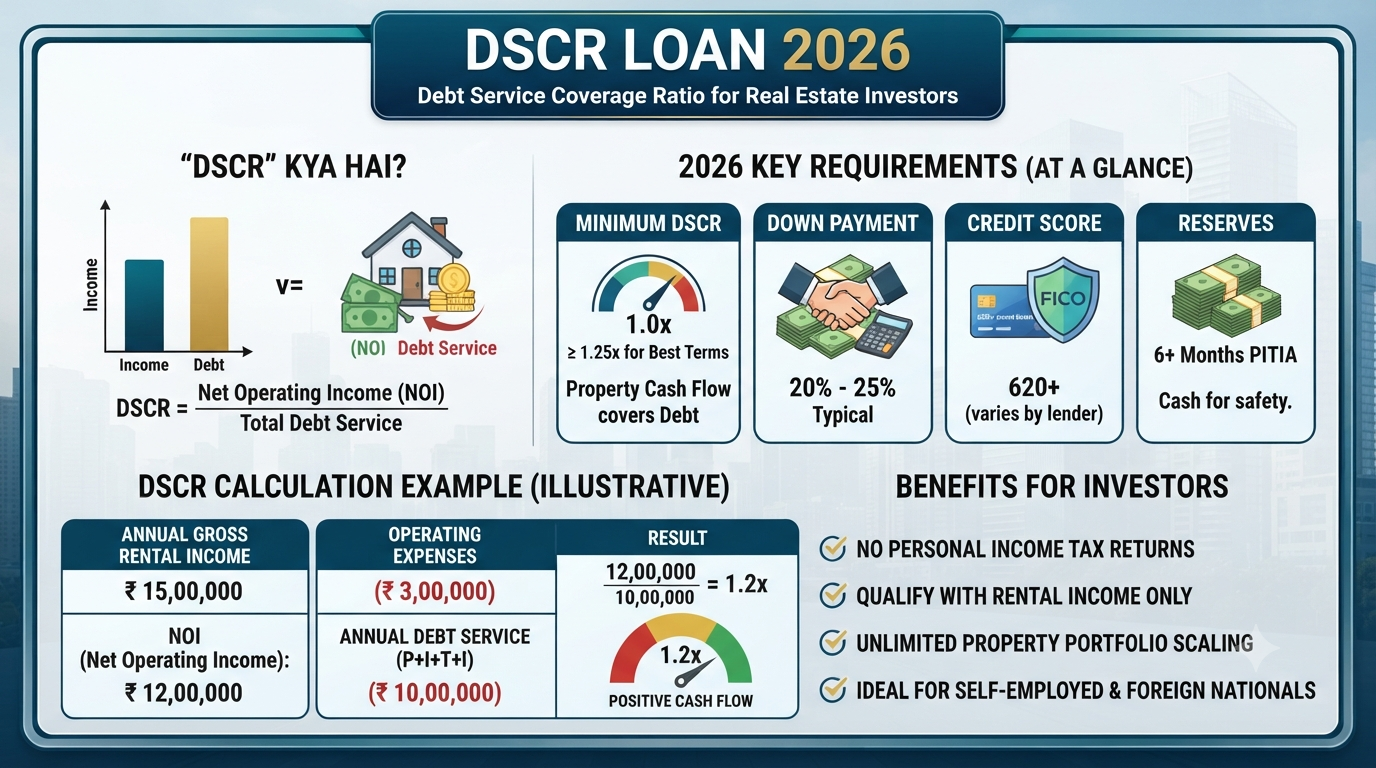
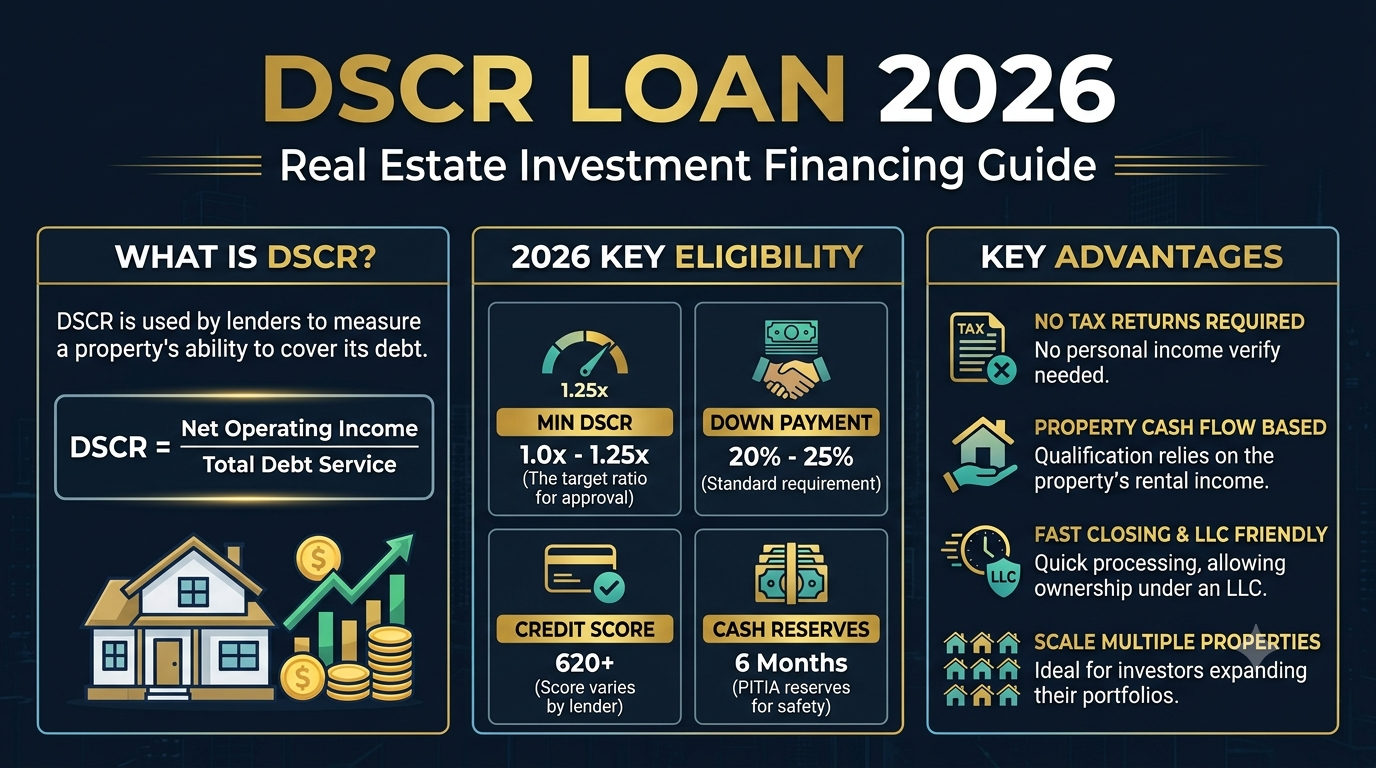
DSCR loan requirements vary between lenders, so there is no single national qualification standard for every investor. However, many programs commonly evaluate a credit score around 620 to 680 or higher, a down payment of approximately 20% to 25%, a qualifying DSCR around 1.00 to 1.25, and sufficient cash reserves. Some lenders offer more flexible options for borrowers with lower DSCR ratios, while others require stronger rental coverage. Investors should understand that a lender advertising a minimum credit score or DSCR does not guarantee approval at that minimum. The complete application is reviewed based on the borrower’s credit profile, property details, loan amount and other underwriting factors.
1. Minimum Credit Score
Credit score is an important factor in DSCR loan underwriting. Many lenders publish minimum credit score requirements beginning around 620, while other programs may prefer scores of 660, 680 or higher. A stronger credit profile can help investors access more favourable pricing or higher loan-to-value options. Lenders may also review previous mortgage payment history, outstanding debts, credit utilisation and serious credit events. Investors should check their credit reports before applying and correct any errors that could affect the application.
2. Down Payment Requirements
A down payment is another major consideration when applying for a DSCR loan. Many investment property programs commonly require approximately 20% to 25% down, although some lenders may offer different leverage options for particularly strong applications. A borrower purchasing a property for $300,000 with a 20% down payment would contribute $60,000 toward the purchase price, before closing costs and prepaid expenses. A larger down payment reduces the loan amount and may improve the property’s DSCR by lowering the monthly principal and interest payment. Investors should also keep additional funds available for closing costs, repairs, insurance and unexpected property expenses.
3. Minimum DSCR Ratio
Many lenders prefer a DSCR of approximately 1.20 to 1.25 or higher because it provides a rental income cushion above the property’s mortgage-related expenses. Some lenders accept a ratio of 1.00, while certain specialised programs may consider ratios below 1.00 or even offer no-ratio options. These flexible programs may involve higher interest rates, lower maximum loan-to-value ratios or additional financial conditions. Investors should not select a property based only on the minimum ratio advertised by a lender. A stronger rental income margin can help protect against vacancies, unexpected repairs and changes in operating costs.
4. Cash Reserve Requirements
Cash reserves are funds that borrowers keep available after completing the purchase. Lenders may require several months of mortgage-related payments to remain available as a financial safety cushion. Depending on the program, this could commonly be around three to six months of PITIA, although some applications may require more. Reserves demonstrate that the investor has funds to manage the property if rental income is interrupted or unexpected expenses arise. The lender may specify which accounts and financial assets qualify as acceptable reserves.
5. Eligible Investment Property
DSCR loans are generally designed for non-owner-occupied investment properties. Eligible property types may include single-family rental homes, condominiums, townhouses, duplexes, triplexes and four-unit residential properties. Some lenders also offer specialised programs for larger residential portfolios or short-term rental properties. Property condition, location, market demand, rental history and legal rental use can affect eligibility. The investor should confirm that the property meets the lender’s requirements before making a financial commitment.
DSCR Loan Rates in 2026: What Interest Rate Can Investors Expect?
DSCR loan interest rates in 2026 depend on market conditions, lender pricing, borrower credit, rental coverage, down payment and loan structure. Unlike standard conforming mortgages, DSCR loans are generally specialised non-QM investment property products, and there is no single official national DSCR interest rate. Published lender advertisements in November 2026 show selected starting rates in the approximate 6.375% to 7.125% range for certain highly qualified borrowers and loan scenarios. These are advertised starting points, not guaranteed rates for every applicant.
What Affects DSCR Loan Interest Rates?
Several factors can influence the rate offered by a DSCR lender. The borrower’s credit score is important because lenders generally consider stronger credit profiles less risky. The property’s DSCR is also relevant, since rental income that comfortably exceeds mortgage-related expenses may support better pricing than a property with a ratio below 1.00. The loan-to-value ratio can affect pricing as well, meaning investors who make larger down payments may qualify for different terms.
Property location and type can also matter because lenders may assess local rental demand, property liquidity and market conditions. Loan size, refinance purpose, short-term versus long-term rental use and the length of the prepayment penalty can further influence the final quotation. For this reason, investors should request personalised quotes from more than one lender before choosing a financing option.
Benefits of DSCR Loans for Real Estate Investors
One of the biggest benefits of DSCR financing is that it focuses primarily on the property’s rental income rather than traditional personal income documentation. This can be helpful for self-employed investors, entrepreneurs and business owners whose tax returns may not reflect their full financial capacity. Another advantage is that investors may be able to finance additional rental properties without following the same income qualification process used by many conventional mortgage programs. Certain lenders allow eligible borrowers to purchase investment properties through an LLC, which may fit their existing business structure.
DSCR loans can also provide an option for refinancing an existing rental property, including some cash-out refinance programs where permitted. The streamlined income documentation may make the process more convenient for investors who have organised rental property portfolios. Nevertheless, these benefits should be considered alongside the cost of financing, credit requirements, reserves and possible prepayment penalties.
Disadvantages and Risks of DSCR Loans
Although DSCR loans offer flexibility, they also have disadvantages that investors should understand before borrowing. Interest rates and fees can be higher than those associated with some conventional mortgage products, especially for borrowers with lower credit scores or weak rental coverage. Down payment requirements can also be substantial, meaning investors need significant funds before purchasing a property. Some DSCR loans include prepayment penalties that may apply if the borrower pays off the mortgage early or refinances during a specified period.
Can You Get a DSCR Loan Through an LLC?
Many DSCR lenders allow eligible real estate investors to purchase or refinance rental properties through a limited liability company. An LLC can help investors organise property ownership, maintain business records and separate certain business activities from their personal affairs, subject to applicable law. This structure can be useful for investors who own several rental properties or operate their real estate investments as a business.
However, lenders may require company formation documents, an operating agreement, an employer identification number (EIN), ownership details and authorisation documents. Some lenders may also require a personal guarantee from one or more owners. LLC ownership does not automatically remove personal financial responsibility for the mortgage. Investors should discuss the legal, tax and lending implications with qualified professionals before selecting an ownership structure.
DSCR Loans for Short-Term Rental Properties
Short-term rental properties, including eligible vacation rentals, may qualify for certain DSCR loan programs. These properties can generate income through platforms such as Airbnb and Vrbo, but their rental income can change depending on location, season, occupancy and local regulations. Some lenders accept documented rental history, while others may consider third-party rental estimates or market projections. The lender may apply its own adjustments to projected income to account for seasonal fluctuations and operating risk. Investors should also review local zoning rules, homeowners association restrictions, licensing requirements and short-term rental regulations before purchasing a property. A property that appears profitable based on peak-season bookings may not generate enough income throughout the year to support its mortgage payments.
Documents Required for a DSCR Loan
DSCR loans may require less personal income documentation than traditional mortgages, but borrowers still need to provide important financial and property records. Commonly requested documents include government-issued identification, credit authorisation, purchase agreement, property details, insurance information, lease agreements and rental income records.
How to Apply for a DSCR Loan in 2026
The first step is to identify an eligible investment property and estimate its realistic monthly rental income. Investors should research comparable rental properties in the same neighbourhood and avoid relying on overly optimistic income projections. Next, calculate the estimated PITIA payment using the expected loan amount, interest rate, property taxes, insurance and HOA dues. Divide the qualifying monthly rental income by the estimated PITIA to calculate the preliminary DSCR.
After reviewing the property’s financial potential, compare DSCR loan programs from different lenders. Check their minimum credit scores, down payment requirements, reserve rules, loan limits, interest rates and prepayment penalties. Once a suitable lender is selected, submit the application and the required financial and property documents.
Conclusion
DSCR Loan 2026 is an important financing option for real estate investors in the United States who want to purchase or refinance eligible rental properties using property income as a major qualification factor. Instead of relying mainly on traditional personal income documentation, lenders examine whether the property’s qualifying rental income can support its mortgage-related expenses. This can make DSCR financing useful for self-employed borrowers, business owners and investors building rental property portfolios.